Virtual staging rules, state-by-state
California, New York, Florida, Texas, Washington — what each state expects from real estate agents using virtual staging, and where the rules differ.
Published April 19, 2026 · 9 min read
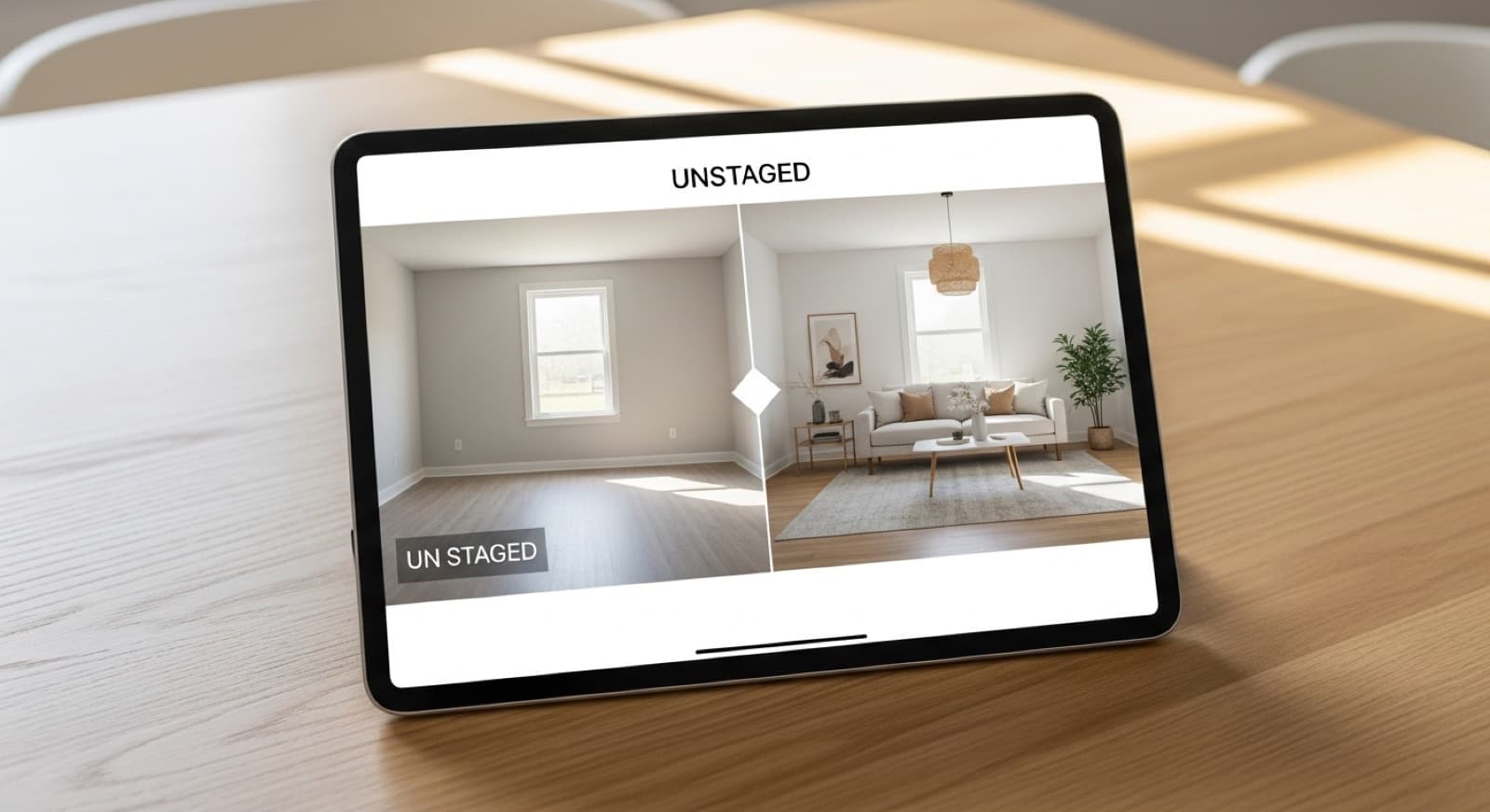
Virtual staging rules are not federal. They are the product of state statute, state real estate commission guidance, MLS policy, and NAR's Code of Ethics — and they stack in different ways in different places. An agent licensed in Florida who takes a listing in California inherits California's rules, not Florida's.
Below is a plain-English reference for the five highest-volume states with the most explicit virtual-staging language. If your state isn't listed, NAR's Standard of Practice 12-1 and your MLS's altered-image policy are the baseline.
California — AB 723
California is the strictest state on paper. AB 723 requires explicit disclosure of digitally altered listing photos and access to the unaltered original on request. Virtual staging falls squarely inside the law's scope. In practice, the California Association of Realtors recommends a short inline disclosure in the MLS description and the original photo archived for 12 months minimum.
The Department of Real Estate has independent authority to discipline agents who misrepresent property through digital alteration. The exposure runs both through real estate disciplinary channels and through civil consumer-protection law.
New York — REBNY + NY Department of State
New York has no AB 723 equivalent, but the Department of State has publicly taken the position that AI-generated or digitally altered listing photos that mislead a buyer constitute deceptive advertising — which is already actionable under existing state consumer-protection law.
REBNY, which covers most of NYC's high-volume brokerages, requires altered images to be identified in the listing. The stricter five-borough MLSes often expect a paired original alongside the staged version rather than just a text disclosure. Outside NYC, NY State MLS and Hudson Gateway follow a more conventional 'label it clearly' rule.
Florida — FR-BAR + Florida Realtors
Florida Realtors and the FR-BAR forms treat virtual staging as acceptable when clearly disclosed and when structural features stay unchanged. The Florida Real Estate Commission has not published a dedicated statute, but the Realtor Code of Ethics and the FR-BAR disclosure language together cover the same ground as AB 723.
Local MLSes (Stellar MLS in Central Florida, Matrix in South Florida) each publish an altered-image policy. Most require the text 'virtually staged' or equivalent in the photo caption or listing remarks. A few require the original alongside the altered version.
Texas — TREC + NTREIS / HAR
Texas Real Estate Commission rules require that advertising not be misleading. TREC has not published virtual-staging-specific guidance, but the Texas Association of Realtors has, and it tracks the NAR standard: disclose, preserve the original, don't hide defects, don't misrepresent structure.
NTREIS (North Texas), HAR (Houston), and ABOR (Austin) each run their own altered-image policy. HAR has been the most active on enforcement, periodically auditing listings with unlabelled virtual staging.
Washington — RCW 18.85 + NWMLS
Washington's real estate disciplinary statute (RCW 18.85) makes misleading advertising a license-level offense. The Northwest MLS, which covers most of the state's high-volume markets, requires that any digitally altered listing photo be clearly identified as such.
NWMLS policy is strict about structural drift in particular — the MLS will remove photos that add, move, or remove windows, doors, or built-ins. This maps 1:1 to an MLS-safer workflow that runs structural verification on every output.
What the rules have in common
Strip away the jurisdictional differences and the same three principles show up in every state:
- Disclose that the photo has been digitally altered.
- Keep the original photo available for a buyer or buyer's agent who asks.
- Never alter a photo in a way that misrepresents the property's structure or hides defects.
A workflow that does these three things automatically — disclosure text pasted in, original photo preserved, structural integrity verified — supports disclosure requirements across every state above without a lawyer-tailored playbook per state. That's the design target for our MLS-safer mode.
Ready to try MLS-safer mode?
Up to Up to 10 styles per room in 60 seconds. Structural checks on every output.
Free to try. Your first listing photo gets 4 styles on free (up to 10 on paid) — each one runs through the same structural consistency check this post describes.